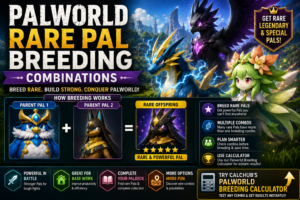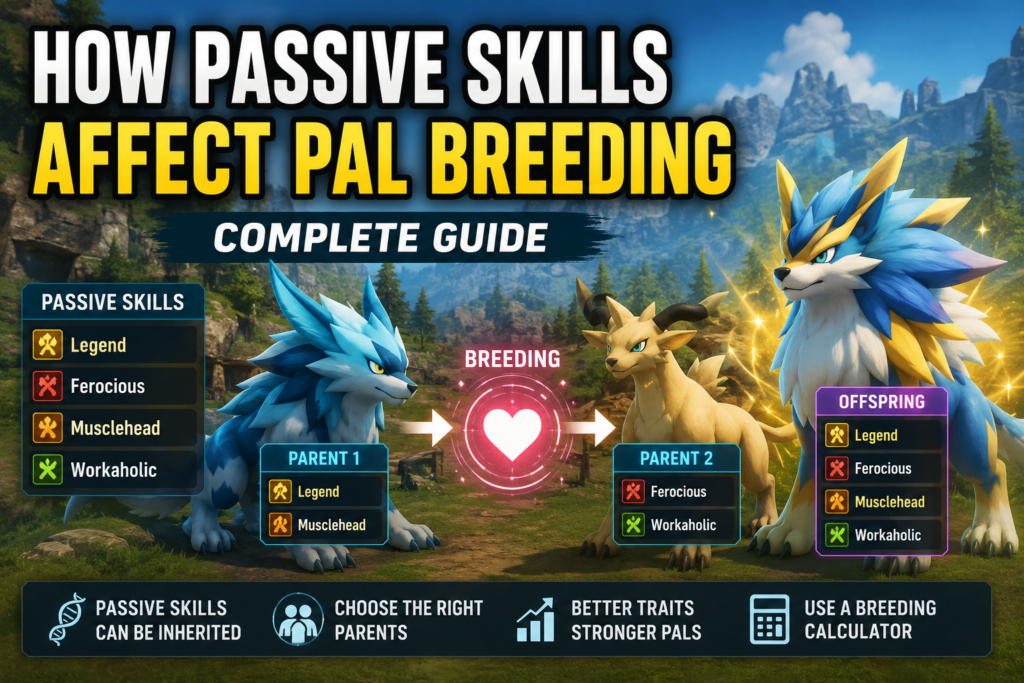
Breeding in Palworld becomes much more interesting when you start paying attention to passive skills. If you are trying to create a powerful combat Pal, a specialized worker, or a Pal with a specific combination of traits, simply choosing two parents is not always enough.
Understanding Palworld breeding passive skills can help you make better breeding decisions and avoid wasting time on random combinations. By looking at the passive traits carried by your parent Pals and planning your breeding route, you can work toward stronger and more specialized offspring.
In this guide, we will explain how passive skills relate to breeding, how passive traits can be passed through breeding, how to select better breeding parents, why multiple generations may be necessary, and how a Palworld Breeding Calculator can help you plan your breeding combinations.
What Are Passive Skills in Palworld?
Passive Skills are traits that provide ongoing effects associated with a Pal. They are different from active skills, which are abilities that a Pal can use during combat or other situations.
Passive skills can be particularly important when you are building a Pal for a specific purpose. Depending on the trait, passive effects can influence characteristics such as combat performance, defense, movement, work efficiency, or other aspects of a Pal’s usefulness.
For casual gameplay, you may not need to worry too much about the exact passive combination. However, once you start optimizing your Pals, passive skills become an important part of the breeding process.
Why Passive Skills Matter
A Pal with useful passive traits can be better suited to a particular role than another Pal of the same species with less useful traits.
For example, a player building a combat-focused Pal may want to prioritize traits that improve combat performance, while someone building a dedicated worker may have completely different priorities.
There is therefore no single passive skill combination that is automatically the best for every Pal. The right combination depends on what you want the Pal to do.
How Do Passive Skills Affect Pal Breeding?
Passive skills matter during breeding because the traits carried by parent Pals can influence the traits available to their offspring.
This is one reason experienced players pay attention to the passive skills of their breeding parents rather than choosing parents only based on their species.
Instead of thinking about breeding as simply:
Parent A + Parent B = Baby Pal
it is more useful to think of breeding as a longer process:
Current Parents → Useful Offspring → Better Parent → Target Pal
This approach is especially useful when the passive skills you want are spread across several different Pals.
How Are Passive Skills Inherited in Palworld?
One of the most important things to understand about Palworld passive skill inheritance is that breeding does not mean you can simply select a set of traits and guarantee that the offspring will receive exactly those skills.
Breeding outcomes can vary, which means that a parent carrying a desirable passive skill does not automatically mean every offspring will receive that same trait.
This is why breeding for specific passive skills can require patience and multiple attempts.
However, careful parent selection can make the process much more organized. If you already have Pals carrying useful traits, those Pals can become valuable parts of a breeding chain.
A Simple Passive Skill Breeding Example
Imagine you have two Pals.
- Parent A: carries two passive skills that you want.
- Parent B: carries two different passive skills that you also want.
Your goal is to eventually create a Pal with a useful combination of those traits.
The first offspring may not contain everything you want. Instead of viewing that result as a failure, you can examine its traits and determine whether it can become a useful parent for the next breeding step.
This is the basic idea behind planned Pal breeding.
Can You Choose Which Passive Skills a Baby Pal Gets?
You cannot simply open a menu and select the exact passive skills you want the offspring to inherit.
Breeding involves inheritance and chance, so obtaining a specific combination may require multiple attempts.
However, you can make your breeding process much more deliberate by choosing parents that already carry desirable traits.
This is the difference between random breeding and planned breeding.
Random Breeding
With random breeding, you choose two Pals without considering their passive skills or the breeding route. You may eventually produce something useful, but many breeding attempts may not contribute toward your final goal.
Planned Breeding
With planned breeding, you first decide what you want to create. You then look for parent Pals with useful traits and choose breeding combinations that move you closer to the desired result.
Planned breeding does not remove the element of chance, but it gives each breeding attempt a clear purpose.
How to Breed Pals With Good Passive Skills
If your goal is to breed a Pal with desirable passive skills, start by defining the final result you want.
1. Choose Your Target Pal
Start with the Pal you ultimately want to create. Knowing your target helps you work backward and determine which breeding combinations may be useful.
Instead of asking which two Pals you should breed first, ask what breeding path can eventually lead to your target Pal.
2. Decide Which Traits You Want
Next, identify the passive skills that make sense for your intended build.
A combat Pal may require different priorities from a Pal intended for work or another specialized role. Avoid choosing traits simply because they are popular. Think about what you actually need from the Pal.
3. Find Parents Carrying Useful Traits
Check the Pals you already have and look for individuals carrying useful passive skills.
A Pal does not have to be your final target to be useful. Sometimes a Pal with one valuable trait can become an important parent in a later generation.
4. Plan Your Breeding Combination
This is where a Palworld Breeding Calculator can save time.
Rather than manually checking a large number of possible combinations, you can use a calculator to explore potential breeding routes and identify parents that can help you reach your target.
5. Evaluate the Offspring
After breeding, inspect the resulting Pal and its passive skills.
If the offspring is closer to your desired result, it may be worth keeping as a future parent. If it does not help your breeding route, you can reconsider your next combination.
Why Perfect Pal Breeding Can Take Multiple Generations
Creating a Pal with a specific combination of traits may require more than one generation.
This usually happens when the useful traits you want are distributed among different Pals.
For example, imagine that one Pal carries a trait you want while another Pal carries a different desirable trait. You may need to create an intermediate Pal first and then use that offspring in another breeding combination.
This is why Palworld perfect breeding is better understood as a process rather than a single breeding attempt.
A useful intermediate Pal can become the bridge between your current collection and the final Pal you are trying to create.
What Makes a Good Breeding Parent?
A good breeding parent is not necessarily the Pal with the highest overall stats or the Pal you personally use most often.
For breeding purposes, a Pal can be valuable simply because it carries a passive skill that you want to introduce into another breeding line.
When selecting a parent, consider:
- The Pal’s species.
- Its current passive skills.
- The traits you want to preserve.
- The possible breeding combinations involving that Pal.
- Whether its offspring could become a useful future parent.
Thinking about future generations can make complicated breeding projects much easier to manage.
Passive Skills vs Active Skills in Palworld
Passive and active skills are not the same thing, and understanding the difference is important when planning a breeding project.
Passive Skills
Passive skills provide ongoing effects associated with the Pal. These traits are particularly relevant when you are trying to optimize a Pal for a specific role.
Active Skills
Active skills are abilities that a Pal can use in appropriate situations, particularly during combat.
If your goal is to create a specialized breeding project, decide whether you are primarily optimizing passive traits, active abilities, or both.
How a Palworld Breeding Calculator Can Help
Once you have more Pals and start exploring different breeding combinations, manually working out possible routes can become difficult.
A Palworld Breeding Calculator provides a more convenient way to explore possible combinations before spending time and resources on breeding attempts.
You can use it to help answer questions such as:
- Which Pals can produce a particular Pal?
- Which parents should I consider?
- What breeding route can lead toward my target?
- Can an intermediate Pal help complete the breeding chain?
- Which combination should I investigate first?
Try the CalcHub Palworld Breeding Calculator to plan your breeding combinations before you start breeding in-game.
Example of a Planned Breeding Strategy
Suppose you want to create a combat-oriented Pal and already have two useful breeding parents.
Parent A has one desirable combat-related passive skill.
Parent B has another passive skill that fits the build you are trying to create.
Rather than repeatedly breeding these Pals without a plan, you can first determine what offspring combinations are possible and decide which result would be most useful for the next generation.
- Define your target Pal.
- Identify the passive skills you want.
- Check your existing Pals for useful traits.
- Explore possible breeding combinations.
- Breed the most promising combination.
- Inspect the offspring.
- Keep useful offspring as potential future parents.
- Continue the breeding chain until you reach your desired result.
The key idea is that every breeding attempt should ideally move your project forward.
Common Palworld Passive Skill Breeding Mistakes
Breeding Without a Target
One of the easiest ways to waste time is to start breeding without knowing what you are trying to create. Define your target Pal and desired traits before beginning.
Ignoring Parent Traits
Don’t look only at the species of your breeding parents. Their passive skills can be important when planning a breeding route.
Expecting One Perfect Result
Breeding may require multiple attempts and generations. If the first offspring does not have the exact combination you want, evaluate whether it can still help with your next step.
Discarding Useful Intermediate Pals
An offspring that is not your final target can still be valuable. It may carry a useful trait or provide a better starting point for the next breeding combination.
Manually Checking Every Combination
Once your breeding project becomes complicated, manually checking every possibility can become frustrating. A breeding calculator can help you explore potential routes more efficiently.
Tips for More Efficient Pal Breeding
- Know your target: Decide which Pal you want before starting.
- Identify useful traits: Determine which passive skills fit your intended build.
- Keep useful parents: Don’t discard Pals simply because they are not your final target.
- Plan your route: Consider intermediate breeding steps instead of looking for one perfect combination.
- Track your results: Keep note of useful offspring and breeding combinations.
- Use a calculator: Explore possible breeding routes before committing to repeated attempts.
Frequently Asked Questions About Palworld Breeding Passive Skills
How do passive skills affect Pal breeding in Palworld?
Passive skills matter because useful traits carried by parent Pals can influence the traits available to their offspring. Players who want specialized Pals can therefore select breeding parents based on the passive skills they carry and work through multiple breeding generations.
Can passive skills be inherited through breeding in Palworld?
Passive skills can be passed through breeding, but a specific trait combination should not be treated as guaranteed in every offspring. Breeding outcomes can vary, which is why parent selection and careful planning are useful.
What are the best passive skills for breeding in Palworld?
There is no universal best passive skill combination for every Pal. The right traits depend on the role you want the Pal to perform. Combat-focused Pals and work-focused Pals can have very different priorities.
How do I breed Pals with good passive skills?
Start by choosing your target Pal and identifying the traits you want. Then find parents carrying useful passive skills, plan a suitable breeding combination, evaluate the offspring, and use promising offspring in later generations when appropriate.
Is a Palworld breeding calculator useful for passive skills?
Yes. A breeding calculator can help you explore possible parent combinations and breeding paths before spending resources on repeated in-game attempts. It is especially useful when your target requires several generations.
Why didn’t my Pal inherit the passive skill I wanted?
Breeding does not mean that every desired trait will appear in every offspring. If the result is different from your target, review the offspring and your available parents and adjust the next breeding step.
What is the difference between passive and active skills?
Passive skills provide ongoing effects associated with a Pal, while active skills are abilities the Pal can use in appropriate situations. When planning breeding, decide whether your goal is to optimize passive traits, active abilities, or both.
Final Thoughts
Understanding Palworld breeding passive skills can make breeding much more strategic.
Instead of randomly combining Pals and hoping for the result you want, start with a clear target, examine the passive skills carried by your available parents, and plan a breeding route that can gradually move you toward your goal.
Remember that an intermediate offspring can be valuable even when it is not your final Pal. It may provide the traits or breeding path needed for a later generation.
If you are planning a specific breeding project, use the CalcHub Palworld Breeding Calculator to explore possible combinations and make your next breeding decision easier.