Palworld Passive Skills – Breeding, Inheritance & Best Traits Guide
Palworld passive skills can make a major difference to how well a Pal performs in combat, at your base, or while travelling across the map. Two Pals of the same species may look similar, but their passive traits can make one much stronger, faster, or more productive than the other.
Breeding gives players a way to combine useful passive skills from parent Pals and potentially pass them to their offspring. This guide explains how passive skill inheritance works, which types of traits are useful for different roles, and how to plan combinations using our Palworld Breeding Calculator.
What Are Passive Skills in Palworld?
Passive skills are permanent traits that affect a Pal automatically. Unlike active attacks that must be used during combat, passive skills provide ongoing bonuses or penalties while the Pal is working, fighting, travelling, or supporting the player.
A Pal can have positive passive skills, negative passive skills, or a mixture of both. Positive traits may improve attack, defense, movement speed, work speed, stamina, or another useful stat. Negative traits may reduce performance in one or more areas.
Each Pal can have up to four passive skill slots. This makes breeding especially useful because players can work toward offspring with a focused set of traits suited to a specific role.
How Passive Skill Inheritance Works
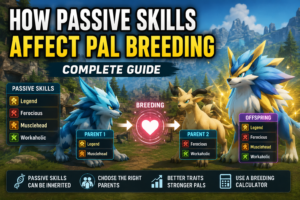
When two parent Pals are placed in a Breeding Farm, the offspring may inherit passive skills from either parent. However, inheritance is not guaranteed. An offspring may receive some desired skills, all of them, none of them, or additional random traits.
This means passive skill breeding usually requires patience. You may need to hatch several eggs before getting the exact combination you want.
- Skills may pass from either parent.
- An offspring can inherit more than one parent skill.
- Inheritance is based partly on chance.
- Random passive skills may also appear.
- Several breeding attempts may be needed for a perfect result.
The species of the offspring and its passive traits are separate parts of the breeding result. Use the calculator to confirm which species two parents produce, then examine the parents’ traits when planning skill inheritance.
Why Passive Skill Breeding Is Important
Breeding for passive skills allows you to create more specialized Pals. Instead of using one Pal for every task, you can build different Pals for combat, base production, transportation, mounting, or player support.
- Combat Pals: Focus on attack, defense and elemental damage bonuses.
- Worker Pals: Focus on work speed and base productivity.
- Mount Pals: Focus on movement speed and stamina.
- Support Pals: Focus on traits that improve player performance.
- Breeding parents: Keep Pals carrying useful traits for future generations.
A planned Pal with four useful passives can perform much better than a randomly captured Pal with unrelated or negative traits.
Best Passive Skills for Worker Pals
Worker Pals should be optimized for base productivity. The most useful passive skills for these Pals generally improve work speed, reduce downtime, or help them move efficiently between tasks.
Popular worker-focused traits include passive skills such as Artisan, Work Slave, Serious and other bonuses that improve work performance. Movement-related traits may also help Pals that spend a lot of time transporting resources across a large base.
- Use work-speed traits for crafting and production Pals.
- Use movement traits for transporting Pals.
- Avoid combat-only skills on a Pal used entirely at the base.
- Avoid negative work-speed traits on production workers.
- Build separate worker and combat Pal lines where possible.
For example, a base Pal designed for crafting does not need four combat traits. Giving it work-focused skills will provide more value during normal base operation.
Best Passive Skills for Combat Pals
Combat Pals benefit from passive skills that improve attack, defense, survivability, or the damage of their elemental abilities. Common combat-focused traits include Musclehead, Ferocious, Burly Body, Legend and elemental attack bonuses.
The best combination depends on the Pal and how you plan to use it. An aggressive damage dealer may benefit more from attack bonuses, while a defensive Pal may need survivability-focused traits.
- Damage build: Prioritize attack and elemental damage.
- Defensive build: Prioritize defense and survivability.
- Balanced build: Combine attack, defense and movement.
- Mounted combat: Consider movement or stamina alongside damage.
Do not automatically copy one set of passives onto every Pal. Consider its element, partner skill, combat role and how often you will use it.
Best Passive Skills for Mount Pals
For ground and flying mounts, movement-related passive skills are often the main priority. Traits such as Swift, Runner and Nimble are commonly used when players want a faster mount.
A mount used mainly for travel may not need work-speed passives. Likewise, a mount used in combat may benefit from a mixture of movement and attack traits.
- Use movement traits for exploration-focused mounts.
- Add stamina-related bonuses where useful.
- Combine speed and attack for combat mounts.
- Avoid filling slots with unrelated base-work traits.
The goal is specialization. A Pal becomes more useful when its passives match the reason you keep it in your active team.
How to Breed for a Specific Passive Skill
Start by finding a parent Pal that already carries the passive skill you want. Then identify a breeding route that can transfer that trait toward your target species.
- Choose the final Pal species you want.
- Decide which passive skills should appear on it.
- Find parent Pals carrying those desired traits.
- Use the calculator to confirm what offspring the parents produce.
- Breed the parents and hatch multiple eggs.
- Keep offspring that inherit the useful skills.
- Use the best offspring as a parent in the next generation if needed.
This process is often called chain breeding because useful traits may need to move through several generations before reaching the final Pal.
How the Breeding Calculator Helps
A passive skill plan is only useful if your selected parents produce the correct offspring species. Our Palworld Breeding Calculator helps you verify the result before using Cake and waiting for an egg.
Select Parent Pal 1 and Parent Pal 2 to check the expected offspring. You can then decide whether that child helps move the desired traits toward your final target.
If you are still learning the basics, read our Palworld breeding guide. For practical pair ideas, explore the best Palworld breeding combos.
What Is Chain Breeding for Passive Skills?
Chain breeding is the process of using multiple generations to transfer one or more passive skills to a target Pal. The first pair may not produce your final species. Instead, it produces an intermediate Pal carrying the desired trait.
That intermediate offspring is then bred with another Pal to move the passive skill closer to the final result. Depending on the target and available parents, the process may require several steps.
A clear breeding route helps you avoid unnecessary generations. Check each pair in the calculator and keep a written note of the parents, offspring and inherited traits.
How to Combine Multiple Desired Passives
Once you have separate Pals carrying the traits you need, breed them together and look for offspring that inherit the strongest combination. Many players try to divide their desired skills between the two parents rather than using parents filled with unrelated traits.
For example, one parent might carry two worker-focused skills while the other carries two additional worker skills. The goal is to produce an offspring with all four useful passives.
- Use parents with relevant skills rather than random extras.
- Avoid unnecessary negative traits where possible.
- Keep promising offspring for later generations.
- Expect to hatch several eggs before obtaining the ideal result.
- Do not discard a useful intermediate breeding parent.
Common Passive Skill Breeding Mistakes
- Using parents with too many unrelated skills: This can make the desired combination harder to obtain.
- Expecting guaranteed inheritance: Passive skill inheritance includes randomness.
- Ignoring the offspring species: Always confirm the result before breeding.
- Mixing worker and combat builds: Specialized Pals usually perform their role better.
- Discarding intermediate Pals: They may be valuable for chain breeding.
- Breeding only one egg: Perfect passive combinations often require multiple attempts.
Preparing enough Cake and maintaining an efficient breeding setup will make repeated attempts easier. Our Palworld Breeding Farm guide explains the full setup process.
Passive Skill Breeding vs Random Captures
Wild captures can provide useful passive skills, but the results are less controlled. Breeding allows you to select parents carrying specific traits and repeatedly work toward a planned offspring.
| Method | Main Advantage | Main Limitation |
|---|---|---|
| Wild captures | Can provide new or random traits | Less control over the result |
| Breeding | Allows planned parent selection | Inheritance is not guaranteed |
| Using both | Find traits, then combine them | Requires preparation and time |
A practical strategy is to capture Pals until you find useful traits, then use those Pals as parents in a planned breeding line.
Frequently Asked Questions
Can offspring inherit passive skills from both parents?
Yes. An offspring may inherit passive skills from either parent. However, the exact combination is not guaranteed, so multiple breeding attempts may be required.
How many passive skills can a Pal have?
A Pal can currently have up to four passive skills at the same time.
Are inherited passive skills guaranteed?
No. Skill inheritance includes an element of chance. An offspring may inherit the desired trait, receive other skills, or fail to inherit it.
What are the best passives for worker Pals?
Worker Pals generally benefit from passive skills that improve work speed and movement around the base. The ideal combination depends on the Pal’s assigned task.
Can I pass a rare passive to another Pal species?
In many cases, passive traits can be moved through breeding generations. You may need to use intermediate offspring before reaching the final species.
Does the breeding calculator show passive inheritance?
The calculator confirms the offspring species created by two parent Pals. Passive inheritance remains chance-based, so inspect each hatched offspring to see which traits it received.
Final Thoughts
Palworld passive skill breeding is one of the best ways to create specialized Pals for combat, base work, mounting and long-term progression. Start with parents carrying useful traits, confirm the offspring species and hatch several eggs until you obtain the combination you need.
Use our Palworld Breeding Calculator to verify each parent pair before breeding. With careful planning and patience, you can move valuable passive skills through generations and build stronger, more useful Pals.
“`